
Exploring the mystery of dying
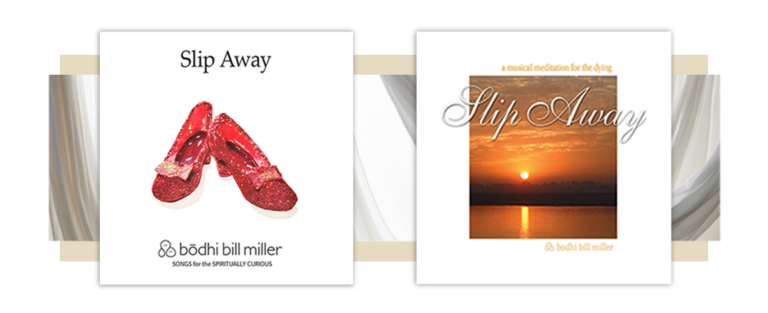
I WROTE SLIP AWAY for my mother after she was diagnosed with inoperable stage-4 cancer. I was fortunate to be at her bedside and to sing this to her, in coma, as she passed. It was profoundly transcendent for me, and judging by her physical transformations, for her as well.
“Little One, don’t be afraid, as your old life starts to fade…”
Dying is a mysterious process. The experience of being with the dying is impossible to describe except to say it can be profoundly, if unexpectedly, spiritual. Mine was. So much so that shortly after her death, I volunteered for hospice where I discovered that end-of-life chaplaincy was not about inserting religion but drawing out what is meaningful from the dying and their loved ones—what I began to call spiritual improv. It was no less creative than designing an ad campaign, while much more real and satisfying. I was smitten.
“Let it go, and leave it here; as you drift off, do not fear…”
While my work as a chaplain is covered in bodhibill.com/about, this is not about me. The reason I’m posting Slip Away as part of the Time Machine album is to open up the mystery of dying to a death-phobic culture. As such, it only works if you sit still and listen deeply.
I hope it opens a new space in your heart.

I offer Slip Away in two versions: a 3-minute song format and as a 12-minute meditation for the dying to ease their transition.

A death of lived spiritual experience
CURIOUSLY, for such a death-phobic culture, American television and movies are fascinated by it—but have no idea what death actually looks like.
In a 2012 Funeralwise TV Body Count Study, researchers examined 320 episodes from 40 popular television series found:
- An average of 7 dead bodies per episode.
- Crime and courtroom dramas featured nearly 3 per episode.
- Action/adventure shot up to nearly 15 per episode.
- Science fiction/fantasy: nearly 10 per episode.
I watch TV and movies too and have yet to see a fictional depiction of death that appeared authentic—and during my chaplaincy work, I witnessed dozens of deaths and hundreds of real bodies so I do know what it looks like.
First off, actual dead bodies do not appear as if they are sleeping. That myth started during the Civil War when embalming was introduced and carries on today.
In the process, Americans lost the wisdom of their elders…
Second, death has been moved from the home to the hospital or other clinical facility. Up to the turn of the 20th century, people died at home and were laid out in the parlor—a typical feature of an American middle-class house. After WWI, as the culture absorbed the horrific introduction of weapons capable of mass slaughter and death became more senseless and overwhelming, the formal parlor began its transition into the more casual “living” room—a transformation that ended with a flourish post WWII with the midcentury modern design revolution—while dying slowly shifted to outside the home. Meanwhile, cabinetmakers expanded their trade into creating funeral “parlors.” So that, in less than a hundred years, death in America was successfully outsourced.
In the process, Americans lost the wisdom of their elders about the physicality and spirituality of dying. Instead, it all became make-believe. Dying is like falling asleep (or being hyper-realistically assaulted and/or blown to bits) and its spiritual aspect is, at best, a warm fill-light and soft-focus lens.
That is a tragic loss that no one blog post can change. But awareness is everything. A spell cannot be broken until we realize we are under its influence. There is much more magic to be found in mundane reality, even if heartbreaking, than at the cineplex if we are only willing to seek it out…
